Liquid Cooling in Data Centers: The Future of High-Density Computing
 Apr 22, 2026
  6 min read
  Facebook
 Twitter
 LinkedIn
 Email
Email
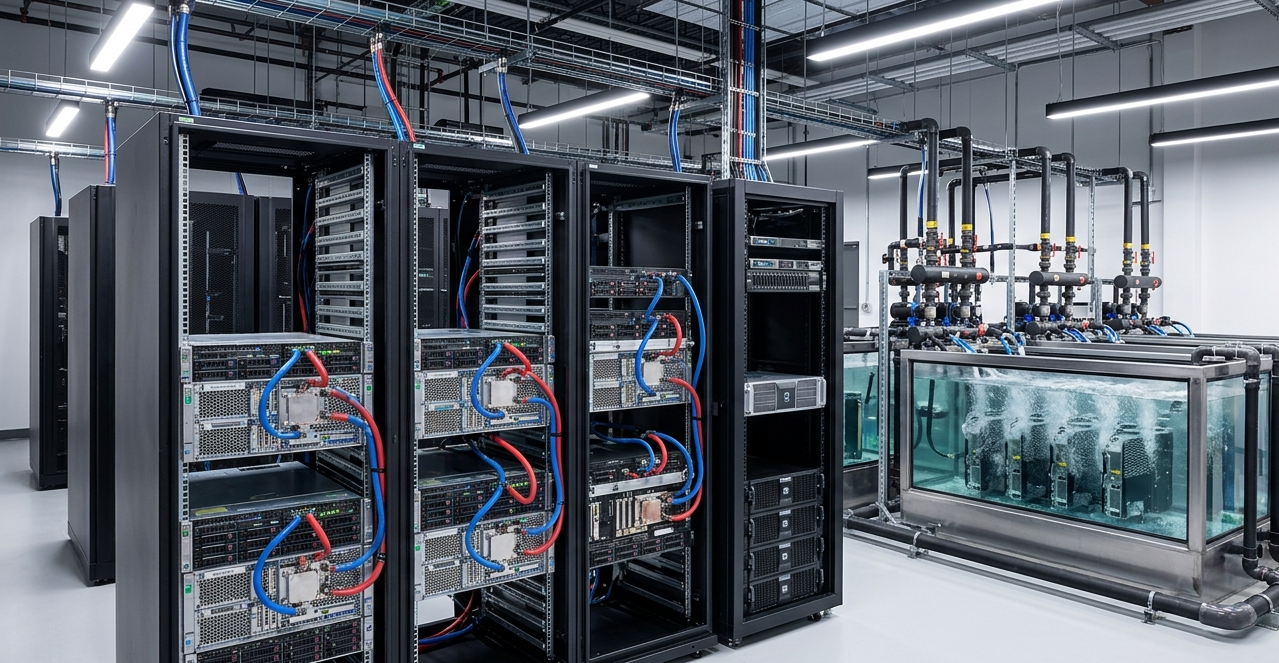
Now that the world has become digital, data centers serve as their backbone. From streaming your favourite shows to running advanced AI tools, everything depends on servers working inside these facilities. But where there are servers, there is heat, and a lot of it.
Managing this heat efficiently has become one of the biggest challenges for modern data centers. Traditional air cooling has worked well for many years, but it is now struggling to keep up with growing computing demands. This is where liquid cooling comes in as a more efficient and reliable data center cooling technology, thereby quickly becoming the future of the liquid cooling data center approach.
Why Air Cooling Is No Longer Enough
For a long time, data centers relied on cold air to cool servers. This method was simple and cost-effective, especially when rack power levels were around 5 to 10 kilowatts (kW).
But things have changed.
Today, AI workloads, cloud computing, and high-performance applications have pushed rack densities to 30, 50, and even over 100 kW. Modern GPUs alone can consume between 500W and 700W each, and a single AI rack can include hundreds of them.
Air cooling cannot remove heat fast enough at this scale. This leads to overheating, reduced performance, and higher energy usage. Liquid, however, absorbs and transfers heat much more efficiently. Water can absorb heat nearly 3500 times better than air by volume. This makes liquid cooling not just an option, but a practical need for modern computing environments.
What Is Liquid Cooling?
Liquid cooling uses special non-conductive fluids to absorb heat from server components and carry it away.
Instead of circulating cold air around equipment, liquid flows directly to the heat source, removes it efficiently, and transfers it out of the system. This helps maintain stable temperatures and allows servers to perform better without overheating.
Types of Liquid Cooling Used in Data Centers
There are three main types of liquid cooling used in today’s liquid cooling data center setups:
1. Direct-to-Chip Cooling
In this method, cold plates are attached directly to components like CPUs and GPUs. Coolant flows through these plates and removes heat at the source.
It works well for AI and cloud workloads and can also be combined with existing air cooling systems, making it easier for data centers to adopt.
2. Immersion Cooling
In immersion cooling, servers are placed inside a special non-conductive liquid. Since the liquid surrounds all components, heat is removed very efficiently.
This method can reduce energy usage by up to 50% compared to traditional cooling. It is also more sustainable, but requires changes in infrastructure.
3. Rear-Door Heat Exchangers
This is a hybrid approach. Here, a liquid-cooled panel is installed at the back of server racks. As hot air passes through it, the heat is removed before the air circulates again.
It is a simple way to introduce liquid cooling without major changes to existing systems.
Key Benefits of Liquid Cooling
Liquid cooling offers several important benefits beyond just heat management:
- Better Energy Efficiency
Liquid cooling reduces the energy required for cooling. Facilities using this data center cooling technology often achieve PUE levels below 1.2, compared to 1.4 to 1.6 for air-cooled setups.
- Higher Compute Density
With better cooling, servers can be placed closer together. This allows more computing power within the same space, which is important for growing AI and cloud demand.
- Lower Carbon Footprint
Lower energy usage means fewer carbon emissions. Many systems also use closed-loop designs that reduce water waste and support reuse.
- Longer Hardware Life
Stable temperatures reduce stress on components, and this helps hardware last longer and lowers replacement costs.
- Quieter Operations
Liquid cooling systems produce less noise compared to traditional fan-based cooling. This reduces wear on equipment.
The Market Is Growing Fast
By 2027, more than half of new hyperscale data centers are expected to use liquid cooling. Many global technology companies are already adopting this approach in their latest facilities.
In India, the demand for digital infrastructure is rising quickly. As AI adoption increases, data centers need to scale in a more efficient and sustainable way. Liquid cooling is expected to play a key role in this growth.
Challenges to Keep in Mind
Like any new technology, liquid cooling comes with some challenges.
The initial setup cost is higher than traditional air cooling. However, energy savings and improved efficiency usually help recover this cost within 2 to 4 years. However, maintenance is also important. Systems need regular monitoring of coolant levels, pumps, and overall performance to avoid issues. With proper planning and expertise, these challenges can be managed easily.
What Is the Way Forward
Liquid cooling is no longer limited to niche use cases. It is becoming a standard part of modern data center design. As processors become more powerful and workloads grow, heat levels will continue to rise. With this, air cooling alone will not be enough to handle these demands.
Hence, the future would likely include hybrid and fully liquid-cooled environments that are more efficient, compact, and sustainable. New systems are also using AI to monitor and optimise cooling in real time. For businesses, choosing a data center that already supports liquid cooling is becoming increasingly important.
Conclusion
Liquid cooling is transforming how data centers operate. It addresses one of the biggest challenges in modern computing, which is managing high heat from dense workloads.
At the same time, it improves energy efficiency, reduces costs, and supports sustainability goals. As AI, cloud services, and digital platforms continue to grow, liquid cooling will play a central role in every future-ready data center.
At Nxtra by Airtel, the focus is on building data centers that are ready for future demands. With energy-efficient designs, scalable infrastructure, and sustainable practices, it supports businesses with reliable and high-performance colocation solutions.
Frequently Asked Questions (FAQs)
1. What is liquid cooling in data centers?
Liquid cooling uses special non-conductive fluids to remove heat from servers. It is more efficient than air cooling and works well for modern high-density computing environments.
2. Is liquid cooling safe for servers?
Yes, it is designed to be safe. Direct-to-chip systems use sealed loops, while immersion cooling uses non-conductive fluids, thereby reducing any risk of damage.
3. How much energy can liquid cooling save?
Liquid cooling can significantly reduce energy usage. Some setups achieve PUE below 1.2, and immersion cooling can lower energy use by up to 50%.
4. Is liquid cooling expensive to set up?
The initial cost of a liquid cooling setup is higher, but energy savings and better performance usually balance this within 2 to 4 years.
5. Can existing data centers switch to liquid cooling?
Yes, many data centers are adopting modular solutions that allow upgrades without rebuilding the entire facility.