AI Data Centers: How Infrastructure is Evolving for the AI Era
 Apr 21, 2026
  6 min read
  Facebook
 Twitter
 LinkedIn
 Email
Email
Artificial Intelligence is changing the world around us, from the apps we use every day to the way businesses make decisions. But for AI to work, it needs a place to run. That place is a data center. As AI becomes more powerful, the data centers that support it also need to grow and change. Today’s AI tools demand far more from infrastructure than traditional systems ever did.
With this blog, look at how data center infrastructure is evolving to support the AI era and what that means for businesses across India and beyond.
Why Old-Style Data Centers Are Not Built for AI
Data centers were already designed to handle everyday computing tasks such as storing files, running websites, and managing business software. These tasks were simple enough that the infrastructure did not need to be very advanced.
But AI works very differently. When a company trains an AI model, it needs thousands of powerful chips that work together continuously for long hours or even days. This requires a huge amount of power and generates a lot of heat. Because of this, traditional setups are no longer sufficient for modern AI workloads.
More Power Per Rack: A Big Shift
The key hardware behind AI is the GPU or Graphics Processing Unit. GPUs are much better than regular processors at handling the type of work AI requires, especially when it comes to running many calculations at the same time.
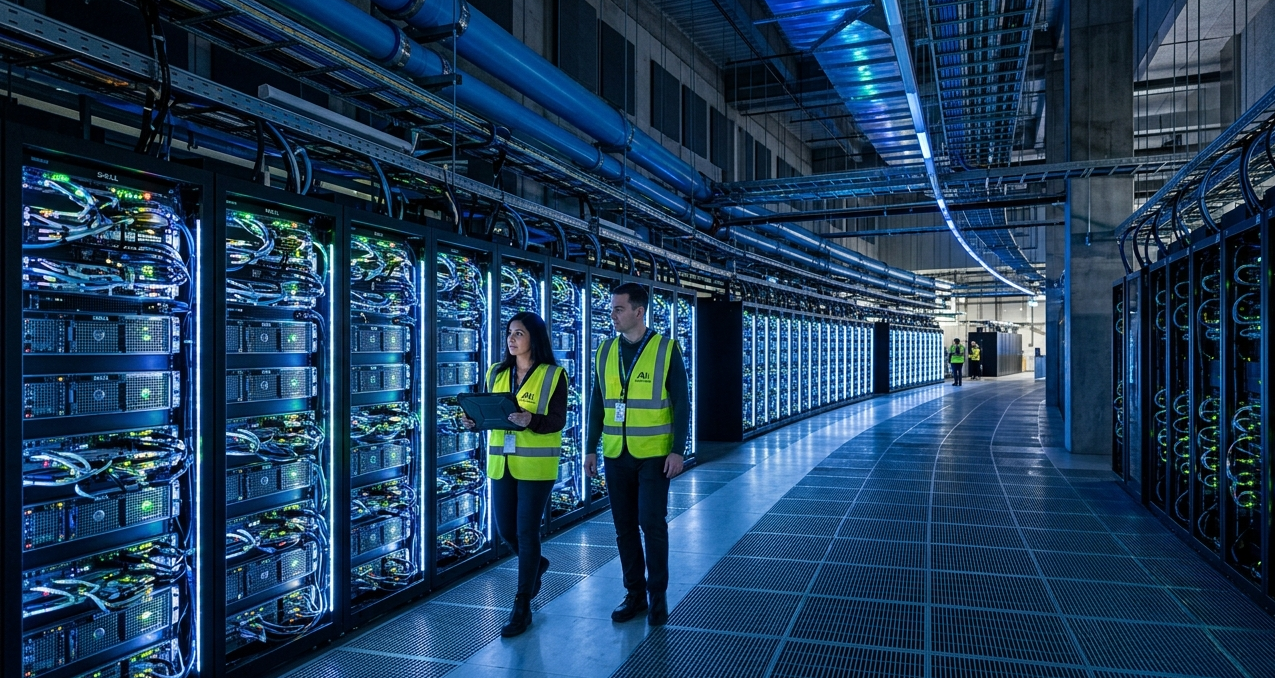
However, GPUs use a lot of power. A standard data center rack used to consume around 5 to 10 kilowatts of power. Today, an AI data center or GPU data center rack can need anywhere from 30 to 100 kilowatts or even more. This sharp increase in power demand is changing how facilities are designed nowadays.
Cooling Gets a Major Upgrade
With extra power comes extra heat. Managing this heat has become one of the biggest challenges in modern AI data center environments.
Traditional data centers use air cooling, where powerful fans push cool air through the facility. This works for normal workloads, but it is not enough for AI systems.
This is why many data centers are moving to liquid cooling. Instead of air, liquid is used to absorb and remove heat more effectively. Some common methods include:
● Direct Liquid Cooling: Liquid-filled plates are placed directly on chips to pull heat away efficiently
● Immersion Cooling: Servers are placed in special liquid-filled tanks that absorb heat
● Rear-Door Heat Exchangers: Cooling panels are added behind racks to capture heat early
Note: Earlier, liquid cooling was used only in a small number of data centers, but today it is becoming a standard choice for AI workloads.
The Growing Demand for Power
AI data centers consume a huge amount of electricity. Training a single large AI model can require thousands of chips, each using significantly more energy than standard processors. As a result of this, a large facility can use as much power as a small city.
In 2024, data center power demand in the United States grew by 19%, showing how fast this need is increasing globally. This trend is now being seen in India as well, as more businesses adopt AI technologies.
For operators, power planning has become critical. They need to ensure stable and reliable electricity while also focusing on cleaner energy sources. Many companies are now investing in solar and wind energy to support their growing needs responsibly.
Faster Networks for Smarter AI
AI workloads depend on multiple chips working together at high speed. This creates a large amount of data moving between servers inside the data center.
Traditional networking systems are not designed for this level of performance. AI data centers require ultra-fast and low-latency connections to make sure smooth communication between systems is maintained. Even small delays can slow down the entire process.
To solve this, modern AI data centers are built with advanced networking systems that support high-speed data movement across the facility.
AI Is Also Making Data Centers Smarter
AI is not just changing what data centers do, it is also improving how they operate.
Operators now use AI tools to monitor systems in real time. These tools track temperatures, predict equipment failures, and automatically adjust settings to improve efficiency. This leads to lower downtime, better performance, and reduced operating costs.
In fact, Nxtra by Airtel became the first data center company in India to use AI for managing its own operations. This helps improve efficiency, reduce energy use, and maintain smooth performance throughout the facility.
Building Green While Going Big
As energy use increases, data centers are under pressure to become more sustainable. The good part is that many of the improvements made for performance also support sustainability.
Technologies like liquid cooling and AI-based monitoring help reduce energy waste. Many operators are also shifting towards renewable energy and working to lower their carbon footprint. Some facilities are even exploring ways to reuse the heat generated by data centers for nearby buildings, thereby making operations more efficient.
Conclusion
The AI era is pushing data centers to evolve quickly. From high-power GPU racks and advanced cooling systems to faster networks and AI-driven operations, the infrastructure behind AI is becoming more advanced every year. Businesses that want to scale their AI operations need a partner that is ready for these changes.
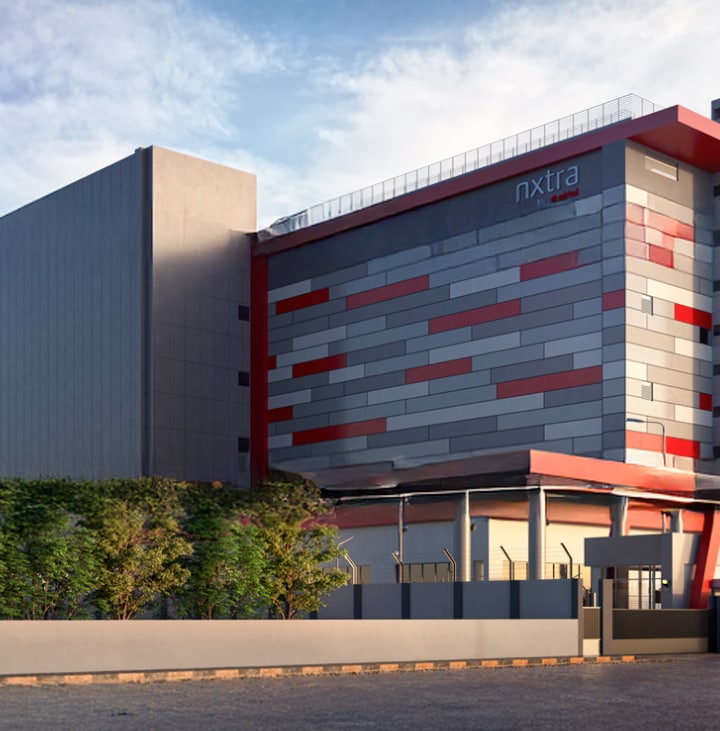
Nxtra by Airtel is built for this new era. As India’s largest data center network, with hyperscale, core, and edge facilities across the country, it is well-equipped to support modern AI data center and GPU data center needs.
Frequently Asked Questions (FAQs)
What makes an AI data center different from a regular data center?
AI data centers are built for high-intensity workloads, using powerful GPUs, higher power capacity, and advanced liquid cooling. The infrastructure is specifically designed to support high-density AI servers, ensuring efficient performance at scale. They also leverage predictive analytics and AI to optimize operations. In contrast, regular data centers handle simpler computing needs with less complex systems.
Why is liquid cooling important for AI?
AI systems generate a lot of heat, which air cooling cannot manage effectively. Liquid cooling removes heat more efficiently, keeps systems safe, and improves overall energy efficiency.
How much power does an AI data center use?
An AI-ready rack can use between 30 to 100 kilowatts of power, compared to 5 to 10 kilowatts in traditional setups.
Are AI data centers harmful to the environment?
AI data centers do use a lot of energy, but operators are improving efficiency by using renewable energy, better cooling systems, and smarter management tools to reduce their impact.
What should businesses look for in an AI-ready data center?
Businesses should look for an AI-ready data center with high power density, support for advanced cooling like liquid cooling, and fast, low-latency networking. It should also have robust security, scalable infrastructure to handle growing AI workloads, and a strong commitment to sustainability.