Data Center Migration: A Complete Guide for Enterprises
 Jul 28, 2026
  4 min read
  Facebook
 Twitter
 LinkedIn
 Email
Email

Data center migration is the process of moving an organization’s IT infrastructure, including servers, applications, and data, from one facility to another. This could mean moving from an on-premises setup to the cloud, shifting between cloud providers, or relocating to a new physical data center altogether.
For enterprises, migration is rarely just a technical exercise. It affects business continuity, customer experience, and compliance. Done well, it improves performance and cuts costs. Done poorly, it can lead to downtime, data loss, and security gaps. This is why more enterprises are turning to professional data center migration services to manage the complexity involved.
What Does Data Center Migration Involve?
As mentioned earlier, data center migration is all about relocating physical servers, virtual machines, applications, storage systems, and network configurations from one environment to another. The destination could be a new physical data center, a colocation facility, or a public or private cloud platform.
Why Enterprises Migrate Data Centers
Businesses migrate for several practical reasons.
Ageing infrastructure is one of the most common triggers. Older data centers often cannot support modern workloads like AI and high-density computing.
Cost is another major factor. Maintaining ageing facilities can be more expensive than moving to modern, energy-efficient colocation infrastructure. Scalability needs also push enterprises to migrate.Growing enterprises need access to scalable space, power and cooling without repeatedly investing in new facilities.
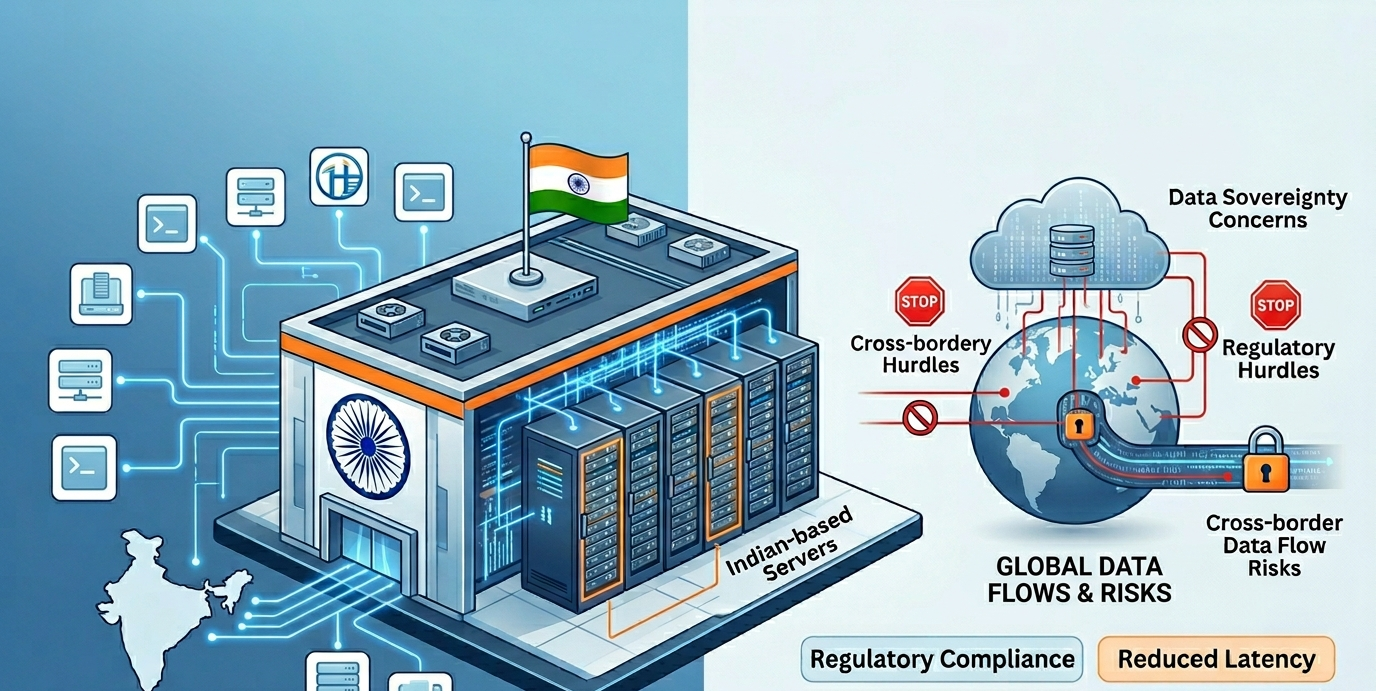
Data-residency and compliance requirements are also influencing migration decisions, particularly for enterprises managing sensitive or regulated information.
Finally, mergers, acquisitions, and business restructuring often require consolidating or relocating IT systems.
Key Challenges in Data Center Migration
Migration projects are complex, and here are some challenges that commonly arise.
- Downtime risk is the biggest concern. Any interruption to critical systems can affect revenue and customer trust.
- Data loss or corruption during transfer is another serious risk, particularly with large or interdependent datasets.
- Application compatibility issues can come up when legacy applications do not perform well in new environments.
- Security vulnerabilities may appear during the transition window, when data is in transit or systems are being reconfigured.
- Cost overruns are common too, especially when migrations are not properly scoped or planned in advance.
The Data Center Migration Process: A Step-by-Step Approach
A well-structured migration generally follows six stages.
- Assessment and Planning: This stage involves auditing existing infrastructure, applications, and dependencies. Enterprises identify which workloads need to move, in what order, and what risks are involved.
- Strategy Selection: Based on the assessment, businesses choose an approach such as rehosting, replatforming, or a full application redesign.
- Design and Architecture: Here, teams design the target environment, covering network architecture, security controls, and redundancy requirements.
- Testing: Before the full migration, a test run helps validate that applications and data will function correctly in the new environment.
- Execution: The actual migration takes place, often in phases to minimize disruption.
- Validation and Optimization: After migration, teams verify performance, security, and compliance, and make adjustments as needed.
Best Practices for a Smooth Migration
A few practices consistently reduce migration risk.
- Start with a detailed inventory of applications and their dependencies, since unknown dependencies are one of the most common causes of migration failures.
- Prioritize workloads based on business criticality, moving less critical systems first to build confidence before tackling core operations.
- Build in redundancy and rollback plans so operations can continue if something goes wrong during the transition.
- Use detailed migration runbooks and conduct rehearsals for shutdown, transportation, installation, validation and rollback.
- Communicate clearly with stakeholders throughout the process, since IT teams, business units, and customers all need visibility into timelines and potential impact.
- Choose experienced migration partners who bring proven processes and reduce the burden on internal teams.
How to Choose the Right Data Center Migration Partner
When selecting a partner for migration, enterprises should look at:
- Track record with similar migrations
- Compliance certifications relevant to their industry
- Availability of local infrastructure to reduce latency
- Support for hybrid and multi-cloud environments
- Post-migration support and monitoring capabilities
A strong migration partner does not just move data. It helps design a future-ready infrastructure strategy.
Conclusion
Data center migration is a significant job, but with the right planning, strategy, and partner, enterprises can move infrastructure with minimal disruption. Whether the goal is cost savings, scalability, or compliance, a structured approach backed by experienced data center migration services makes the difference between a smooth transition and a costly setback.
This is where Nxtra by Airtel comes in. Nxtra offers colocation, managed services, and infrastructure built to support high-density and AI-ready workloads across its facilities in India. With a strong local footprint, Nxtra helps enterprises reduce latency, meet data sovereignty requirements, and scale infrastructure without the burden of managing everything in-house.
FAQs
-
Data center migration is the process of moving servers, applications, and data from one infrastructure environment to another.
-
Timelines vary based on the number of assets, application dependencies, destination readiness, migration distance and acceptable downtime. A detailed assessment is required before a reliable timeline can be established.
-
Operational disruption, equipment damage and overlooked application dependencies are among the most significant migration risks which is why thorough planning, testing, and phased execution are essential.
-
Not necessarily. Complex enterprise environments are often moved in carefully planned phases. This allows teams to validate each migration wave, manage application dependencies and reduce the risk of widespread operational disruption.