AI-Ready Data Centers: What Makes a Data Center Built for AI?
 Jun 15, 2026
  4 min read
  Facebook
 Twitter
 LinkedIn
 Email
Email

Artificial intelligence is changing the way businesses work, train models, and serve customers. But AI does not run on ordinary infrastructure. It needs power, cooling, and networking built for a different scale. This is where AI-ready data centers come in. These facilities are designed from the ground up to handle GPU-heavy workloads without slowing down or overheating. As more Indian enterprises move from AI pilots to full production, it has become important to understand what makes AI data center infrastructure truly AI-ready, especially for anyone planning long-term digital growth.
What Does AI-Ready Actually Mean?
An AI-ready data center is a facility built to support the heavy compute, power, and cooling needs of artificial intelligence workloads. Conventional data centres were primarily designed to support general-purpose enterprise applications and traditional computing environments. AI workloads are different. They involve thousands of GPUs working together, moving huge volumes of data, and generating far more heat than traditional servers. The difference lies in the ability to support greater compute density continuously without compromising performance, efficiency or resilience.
Why Traditional Data Centers Fall Short
The main reason behind it is that traditional data centers were never designed for the density that AI demands. While conventional enterprise racks operate at relatively lower densities, AI training clusters can require 40–100+ kW per rack, with advanced deployments demanding even higher capacities.
This gap creates real problems. Insufficient power and cooling capacity can affect training performance and the reliability of production inference workloads. GPUs can throttle due to heat, which wastes expensive compute resources. This is why enterprises need purpose-built AI data center infrastructure rather than retrofitted legacy facilities.
Key Features That Make a Data Center AI-Ready
High-Density Power: AI workloads need consistent, high-capacity power that can scale without creating single points of failure. This means upgraded switchgear, redundant power paths, and the ability to add capacity as GPU deployments grow.
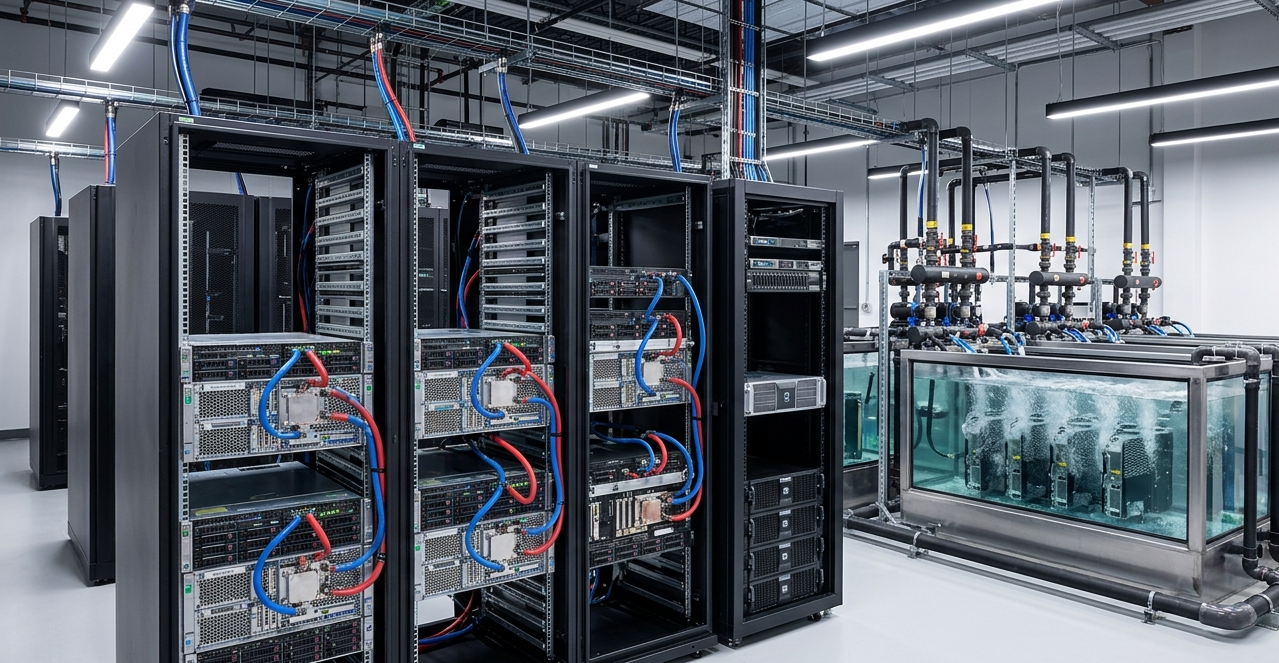
Advanced Cooling Systems: Since AI hardware generates intense heat, air cooling alone is not enough. Many AI-ready facilities now use liquid cooling methods like direct-to-chip cooling, which sends coolant straight to the processor. Some use immersion cooling, where servers sit fully submerged in a cooling fluid. Most facilities today use a mix of liquid and air cooling depending on the workload.
Low-Latency, High-Bandwidth Networking: AI training relies on GPUs constantly exchanging data. Even small delays in this communication can slow down entire training cycles. AI-ready data centers use optimized network architecture designed specifically for GPU-to-GPU traffic, reducing bottlenecks and keeping expensive compute resources fully utilised.
Scalable Storage Architecture: AI workloads generate and process massive datasets. Storage systems need to be fast, flexible, and able to handle sudden spikes in demand without disruption.
Strong Security and Compliance: As AI systems handle sensitive business and customer data, physical and digital security controls matter more than ever. This is especially true for regulated sectors like BFSI and healthcare.
Training vs Inference: Different Infrastructure Needs
AI infrastructure needs to shift depending on the stage of the AI lifecycle. Training large models requires concentrated computing power, usually centralized in facilities that can support the highest densities. Inference, on the other hand, is often spread across multiple locations to reduce latency for end users. Enterprises need to plan for both, since most AI journeys start with training and later demand strong inference capacity as models move into production.
Why This Matters for Indian Enterprises
India’s AI adoption is accelerating across banking, healthcare, manufacturing, and e-commerce. But without the right infrastructure, enterprises risk slower model training, unreliable applications, and rising costs from inefficient compute usage. Choosing AI-ready data centers built specifically for GPU workloads helps businesses avoid these pitfalls while staying ready for future scale.
How Nxtra by Airtel Supports AI-Ready Infrastructure
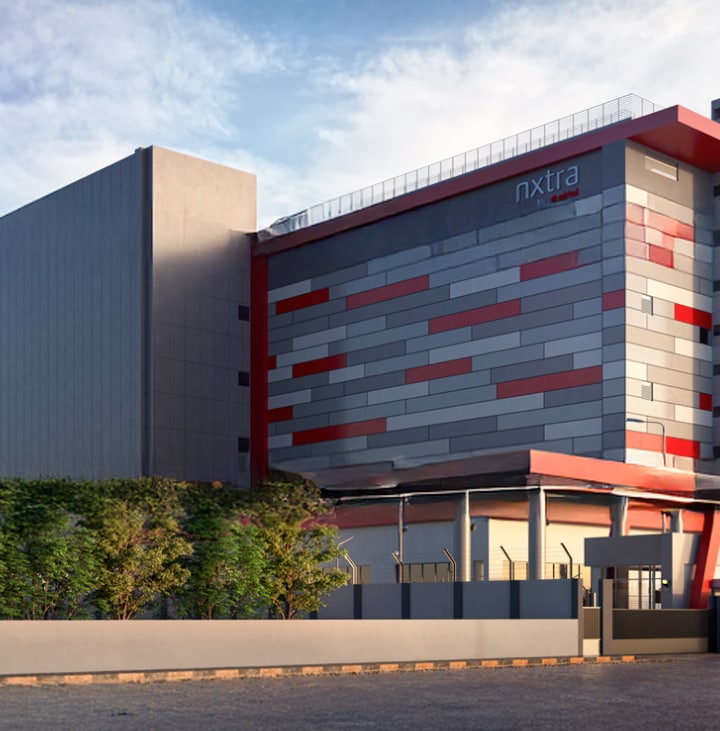
Nxtra by Airtel supports high-density AI and GPU workloads through resilient power infrastructure, scalable capacity and advanced cooling architectures. It is operating one of India’s largest data center networks, with facilities across major cities including Mumbai, Delhi, Bangalore, Chennai, and Hyderabad.
Whether an enterprise is training large models or scaling inference across regions, Nxtra by Airtel’s AI data center infrastructure is designed to keep pace with growing compute demands. This enables enterprises to scale demanding training and inference workloads on infrastructure engineered for performance, resilience and future growth.
FAQs
-
It is a facility built to handle the high power, cooling, and networking demands of AI workloads, unlike traditional data centers designed for general computing.
-
AI relies on GPUs, which consume far more power and generate more heat than standard CPU-based servers, especially during large-scale training.
-
Depending on rack density and hardware requirements, AI-ready data centres can use air cooling, direct-to-chip liquid cooling, immersion cooling or a combination of these technologies.
-
They support high-bandwidth, low-latency interconnection to enable rapid data exchange between GPUs and other computing systems.
-
Yes, providers like Nxtra by Airtel offer AI-ready data center infrastructure across major Indian cities, helping enterprises scale AI workloads without relying solely on overseas facilities.